The Importance of Parent Involvement in ABA Therapy

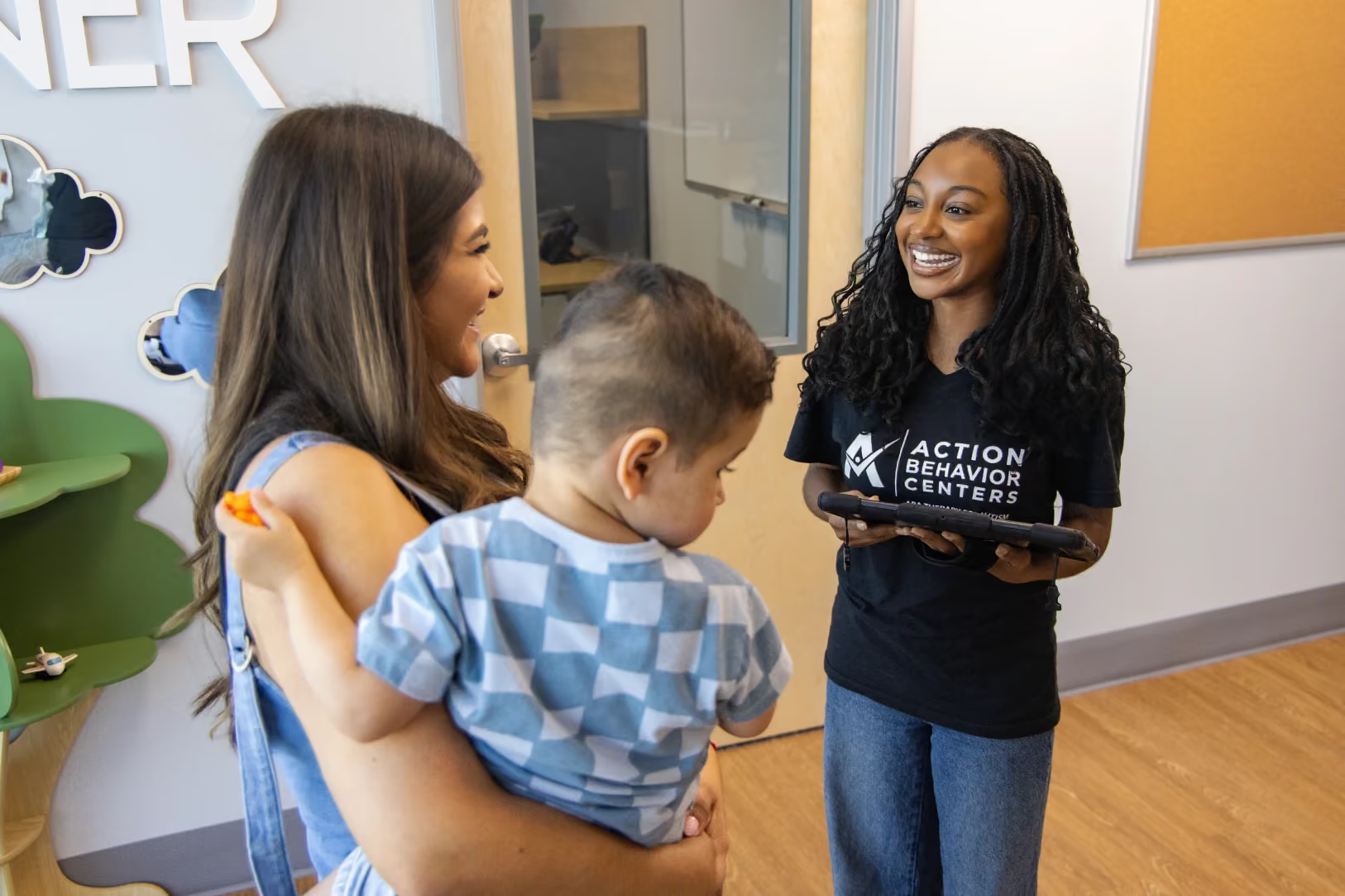
When your child starts applied behavior analysis (ABA) therapy, growth doesn't stop when the session ends. Some of the most meaningful outcomes happen in between sessions: at breakfast, during bath time, on the drive to school, or in the middle of a tough moment. That is why your role as a parent matters so much.
At Action Behavior Centers, families are partners in the process from day one. Board Certified Behavior Analysts® (BCBAs®) and Registered Behavior Technicians® (RBTs®) work directly with your child each day to reach individualized goals. But the moments at home, in the community, and during everyday routines matter just as much. When families stay connected with their BCBA, children have more opportunities to practice what they're learning in real places, with the people they trust most.
Why parent involvement in ABA therapy matters
Children diagnosed with autism spectrum disorder (ASD) often learn best through repetition and consistency. A new skill that comes up during therapy, like asking for help or following a two-step direction, grows stronger every time they practice it. When that practice only happens in an ABA center, a child may find it difficult to use that skill in the real world.
Parent involvement helps bridge that gap. For example, if your child is working on requesting a snack using a picture card at their center, practicing that same step at home, at the kitchen table, with you, is what helps that skill become a natural part of daily life. The more settings and people involved, the more reliably a child can use what they're learning.
Your involvement also gives your child's BCBA a fuller picture. When you share what is happening at home, what feels hard, and what your family needs most, that information directly shapes your child's individualized goals.
Learn more: Tips For Teaching Your Autistic Child At Home (+ Skill Tracker Download)
What ABA parent involvement actually looks like
Parent involvement does not mean running therapy sessions at home. At ABC, it happens through Family Guidance, a structured part of every child's therapy where parents and BCBAs work together regularly to support progress in the center and at home.
Family Guidance sessions are led by your child's BCBA and happen at least twice a month. They are conversations shaped by what your family is actually navigating, and they are where your child's individualized goals get built, monitored, and adjusted over time.
How BCBAs & families set individualized goals together
Goal-setting at ABC is a collaborative process. Your child's BCBA does not arrive with a predetermined plan. They take time to learn about your child's strengths, your family's routines, and what matters most to you before goals are ever set.
During the first Family Guidance session, your BCBA will ask questions like:
- What does your child's best day look like?
- What situations feel hardest right now?
- What would you most like to see change in the next three to twelve months?
They will also want to understand your child's communication needs, sleep and feeding routines, sensory sensitivities, and what your typical day actually looks like. From there, you and your BCBA identify a few starting goals that fit your family's life. Those goals are not fixed. As your child grows and your family's needs shift, your BCBA revisits and adjusts them alongside you.
What families work on in Family Guidance
Family Guidance sessions cover a wide range of topics depending on what your family is navigating at any given time. Common areas include:
- Understanding why certain behaviors happen and how to respond in ways that support safety and connection
- Helping a child communicate using speech, gestures, or pictures
- Breaking down daily routines like getting dressed, brushing teeth, or using the bathroom into manageable steps
- Making transitions smoother, whether that is leaving the house in the morning or adjusting to a new school year
- Using positive reinforcement in everyday moments
- Helping a child apply skills learned in therapy at home, in stores, or on the playground
Sessions can happen in person at your ABC center, through a home visit, or virtually in certain cases. Your BCBA may also walk you through progress data, use video examples, or do real-time practice with you.
ABA therapy outcomes: reduced parenting stress
Starting ABA therapy can feel like a big step, and it is normal to feel uncertain at first. What research shows, though, is that for many families, getting started often brings more relief than pressure over time.
In a study of 298 ABC families, parents completed the Parenting Stress Index when they started therapy, at six months, and again after one year of Early Intensive Behavioral Intervention (EIBI).1 Here is what the data showed:
- Average stress levels improved. Families' scores dropped from the 57th percentile at the start of therapy to the 53rd percentile after one year.
- Families with the highest stress saw the biggest shift. Those starting at the 93rd percentile on average dropped to the 80th percentile within six months and held that progress after one year.
- Starting early makes a difference. Beginning ABA therapy sooner gives families more time to build confidence and feel supported.
- Consistency matters. Regular therapy hours and ongoing communication with your child's treatment team help families feel more grounded as their child grows.
When families feel informed and connected to the process, the day-to-day becomes more manageable. That is something your child's treatment team sees reflected in the data and in the families they work with every day.
Learn more: ABA therapy outcomes & family impact stories
When to talk to someone about your child's development
You do not need to have everything figured out before you reach out for help. If you have been wondering whether your child could benefit from ABA therapy, or if you are already in the process and want to learn more about how Family Guidance works, we are here for you.
You can start with a no-cost online screener to get a better sense of what you are seeing at home. If you are ready to see what ABC looks like for your family, contact us to schedule a tour of your nearest center. You can also verify your insurance coverage to understand your benefits before you get started.
At Action Behavior Centers (ABC), we help children diagnosed with autism spectrum disorder (ASD) reach milestone moments. Compassionate care is at the heart of everything we do, and our highly trained clinicians deliver evidence-based applied behavior analysis (ABA) therapy tailored to each child’s unique needs.
Our autism services include diagnostic support, 1:1 individualized care, parent training, school readiness programs, and Early Intensive Behavioral Intervention (EIBI) across hundreds of centers in Arizona, Colorado, Illinois, Minnesota, North Carolina, and Texas. Because no family should have to wait for help, ABC offers immediate access to care. Contact us today to get started.
.avif)
.avif)