Action Institute for Outcomes Research
In 2024, Action Behavior Centers launched the Action Institute for Outcomes Research (AIoR) to support our mission of advancing behavioral early intervention through cutting-edge treatment outcome research.
The mission of the Action Institute is to deepen the understanding of treatment outcomes to empower behavior analysts, families, and funders with the information they need to make informed care decisions.
Our research findings are integrated into clinical practices to drive continuous improvement in our delivery of services to families. Executive Director, Dr. Linda LeBlanc, leads the research team based on decades of clinical, research, and editorial experience and over 130 publications.
-shirt.jpg)
Meet ABC's clinical research team
The ABC team knows that quality depends on doing the right things at the right time (e.g., core clinical process) and focusing on changes that matter to families (e.g., outcomes). Clients, families, and funders have a right to know how both processes and outcomes are monitored as a reflection of the quality of services provided by an organization. The Action Institute has a team of dedicated, caring professionals who focus on accountability to families and stakeholders and contributing to the scientific literature to advance our understanding of treatment outcomes.

Linda LeBlanc, Ph.D., BCBA-D
Dr. LeBlanc served on the clinical council before stepping into her full-time role as the Executive Director of the Action Institute. She leads our efforts to improve quality, transparency, accountability, and equity in treatment services while advancing our scientific understanding of treatment outcomes and the variables that influence those outcomes. She works with our clinical leadership team to integrate our findings into ongoing clinical processes to ensure improvement in our delivery of services to families.
-%20Jackie%20Benitez.avif)





Clinical process data for 2025
Since our founding, we've carefully built and refined each stage of care, including intake, assessment, treatment, Family Guidance, and discharge preparation, so families have access to high-quality early intervention services for autism.
Our Clinical Directors (CDs) review each child's applied behavior analysis treatment through a structured case review and auditing process. We also track four process-quality metrics, each with a defined goal:
- Teammate hiring and training: Registered Behavior Technician® certification within 40 days of hire
- Manageable caseloads: An average of eight or fewer children per Board Certified Behavior Analyst® (BCBA®)
- Service fulfillment: 90% of authorized hours fulfilled
- Family engagement: Two hours per month of Family Guidance and collaboration
You can review our most recent data on each metric in our outcomes white paper.

90%
Technicians who become Registered Behavior Technicians® (RBTs®) within 90 days
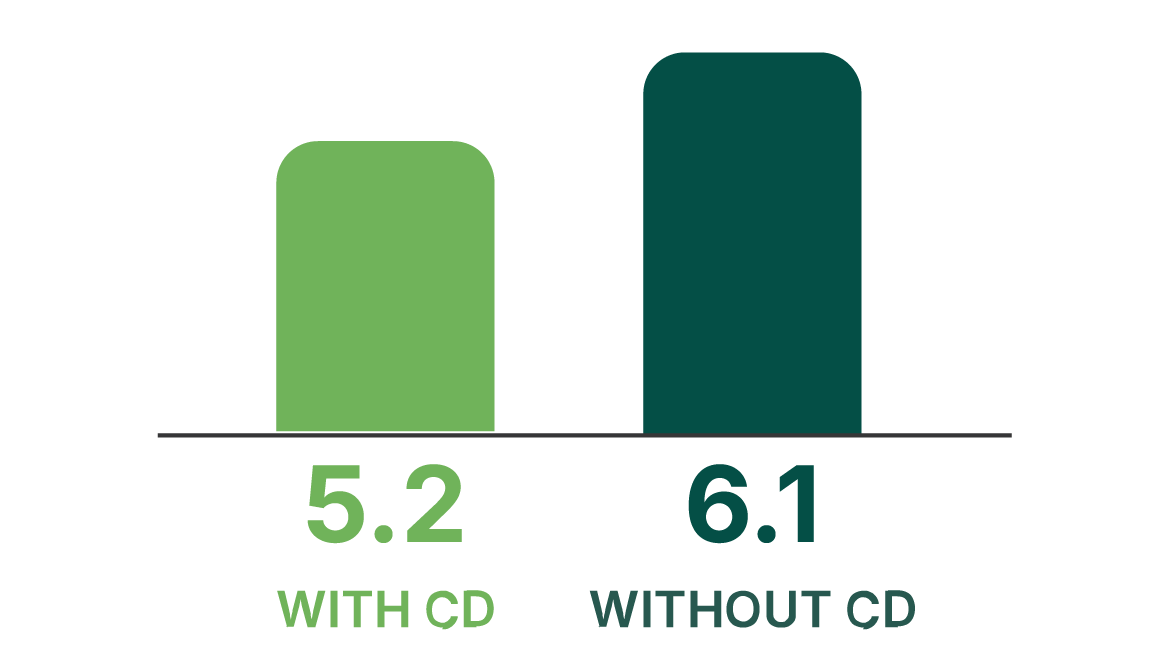
Average case load size with Clinical Directors when compared to those without

1.9
Average number of sessions of Family Guidance per patient per month

73%
Families who received at least two Family Guidance sessions per month
Patient outcomes
The Action Institute also measures the patient outcomes achieved through our treatment efforts. Our families seek early intervention services with goals of:
- Achieving language, social and adaptive skills that will ensure readiness for success in school
- Managing challenging behavior that is most impactful to health and safety
- Minimizing the negative impact of the characteristics of autism on everyday life and functioning
- Ensuring long-term quality of life with less stress for everyone in the family
We measure outcomes related to each of these goals at intake, throughout treatment, at discharge, and at follow up. We take a balanced approach to measurement, incorporating standardized measures that our completed by our clinical team (i.e., clinician reported outcome measures) as well as measures that capture the experience and perspective of our patients and families (i.e., patient reported outcome measures), consistent with the recommendations of the International Consortium of Health Outcome Measures (ICHOM) and the Behavioral Health Center of Excellence (BHCOE).

PARENT AND FAMILY

challenging behavior

Skill Development and School Readiness

Impact on autism characteristics
Summary: White Paper on Reduction of Challenging Behavior
Many of the families we serve are concerned about challenging behaviors, particularly ones that impact health and safety (e.g., *self-injurious behavior, aggression, *elopement). We collaborate with families to develop a behavior intervention plan with the goals of (a) decreasing challenging behavior by at least 80% and (b) achieving that goal within the first year of therapy. We examined the effects of treatment on challenging behaviors for 20 of our clients.
All clients were ages 2–6 with a mean age of 2.9 years at the start of the study and 5.7 years at the conclusion. All had received ABA therapy for at least one year and for an average of 27 months (range 14–37 months).
We measured the frequency of episodes of aggression, elopement, property destruction, and self-injurious behavior at the start of intervention and at the termination of treatment or during the most recent three months of care.
Clients experienced an 86% decrease in challenging behaviors and these treatment effects were maintained as the dosage (i.e., number of treatment hours per week) decreased by almost 20% with the greatest reductions observed during the first year of treatment.
The greatest reductions were observed for aggression and property destruction, which were the most frequent behaviors at the beginning of treatment and the least frequent behaviors at the last measurement.
here*Self-injury refers to any behavior could inflict harm oneself such as biting or slapping oneself or banging any body part against a hard surface.
*Elopement refers to running or wandering away from a caregiver or secure location
Behavior Reduction Percentage

Timing of Administration

The Parenting Stress Index, Fourth Edition Short Form (PSI-4-SF)
The PSI-4-SF is a parent-reported measure of the stress associated with the role of parenting. Parents of children diagnosed with autism often experience higher levels of stress than parents of neurotypically developing children or children with other identified conditions including intellectual and developmental disabilities (Hayes & Watson, 2013).
Parents of children served at Action Behavior Centers are asked to complete the PSI at intake and every six months throughout treatment. LeBlanc et al. (2024) conducted a longitudinal study of parenting stress with 422 families who completed the PSI at intake, six months into treatment, and one year into treatment. For these families, the average initial PSI scores fell at the 57th percentile, decreasing to the 53rd percentile at one year of treatment.
For the families that were the most stressed at intake (n = 45; 10% of the sample), the average initial PSI scores were at the 93rd percentile indicating very clinically significant levels of stress. The average scores decreased to the 80th percentile at one year of treatment indicating a reduction in parenting stress.
In a follow-up study of 3,324 families completing the PSI at intake, the mean percentile score was 59.3 with 12.5% (n = 415) experiencing elevated levels of stress. Older child age at diagnosis, more challenging behavior, lower adaptive behavior, and having multiple children diagnosed with ASD were associated with higher parenting stress.
School Placement Outcomes
Action Behavior Centers provides early intervention services and strives to prepare patients to succeed after intervention in school and everyday life in the least restrictive and most inclusive environments. Thus, we track school placement for families who exit services at school age.
We send an electronic follow-up survey three months after discharge to families who exit services as part of our graduation process (i.e., all metrics and goal achievement suggest the child is ready to transition out of service) or who choose school (i.e., additional services are recommended but the family chooses to transition to school).
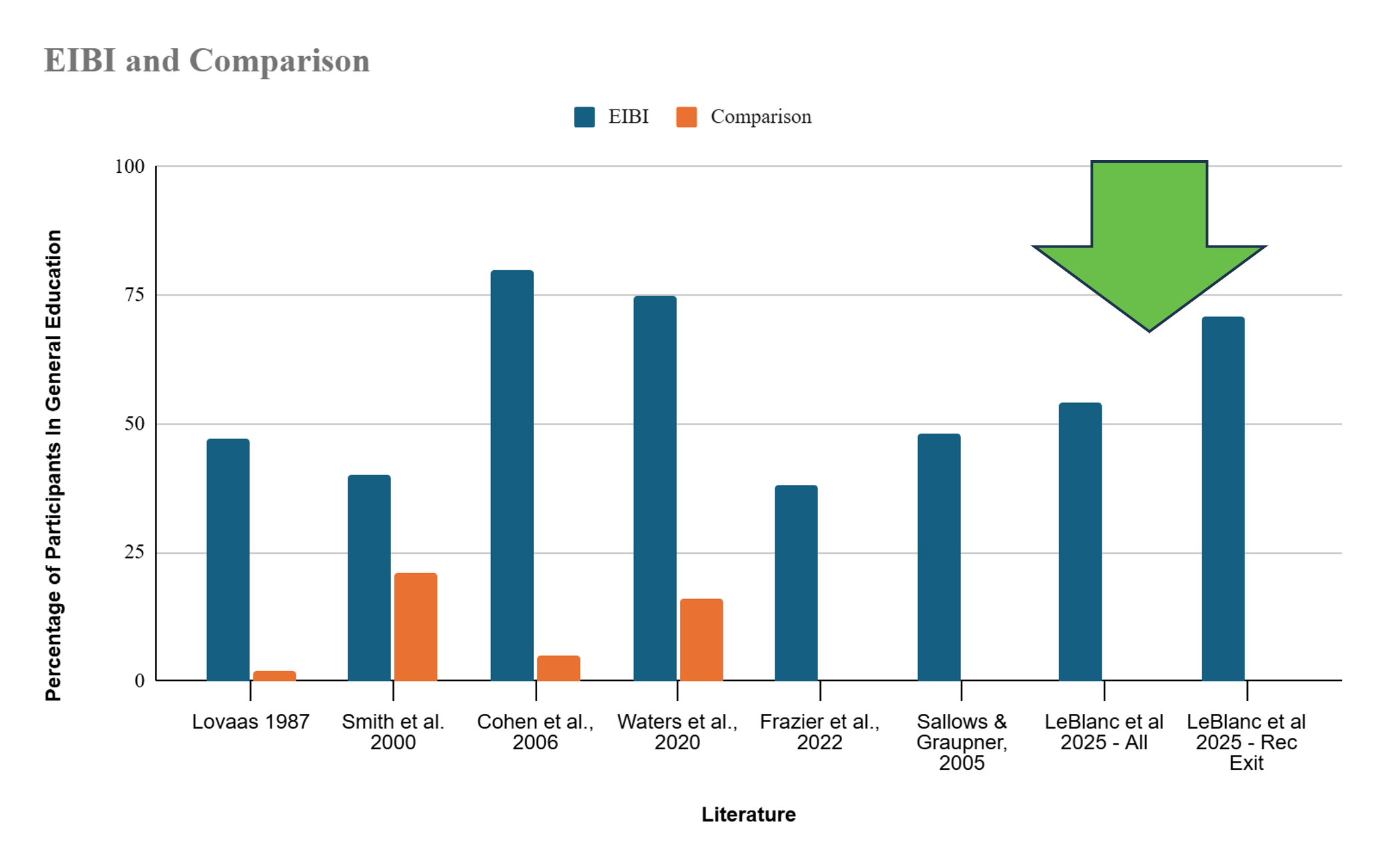
LeBlanc et al. (2025) examined the school placements for 193 children who exited services August 2022 through November of 2023 and who responded to the survey. Overall, 54% of children were served primarily in general education and 80% of children had an Individualized Education Program (IEP).
Placement percentages for general education were significantly higher for those who had a recommended discharge in the graduation process (71%) than those who chose school rather than continuing with recommended treatment (42%).
Additionally, 32 participants responded to a second survey an average of 5.5 months after the first response and the majority of children (i.e., 28 of 32, 87.5%) maintained their initial school placement while 3 of 32 (9.3%) moved to a less restrictive placement and one moved to a more restrictive placement.
The preliminary analysis for 272 patients exiting between December 2023 and September 2024 indicates that the overall percentage served primarily in general education increased (60%) and the percentage increased for each group with the same pattern of differential placement by discharge category: graduated (84%), recommended exit (68%) and chose school (52%).
EIBI and Comparison

The Bracken School Readiness Assessment – Third Edition (BSRA-3)
The BSRA-3 is a norm-referenced standardized assessment that provides a quick screening of concept knowledge to help determine if a child is ready for school. The BSRA-3 is conducted with clients of Action Behavior Centers who are nearing discharge to inform our discharge planning, to guide final phases of treatment, and to evaluate the outcomes of our EIBI treatment model. Data collection is currently underway.
Curriculum and Adaptive Behavior Measures
At intake and every six months throughout treatment, our BCBAs assess patient skills using measures that guide our goal selection and curriculum implementation. That is, these assessments help us know what to teach next in order to build strong learning, communication, adaptive, and social foundations for future success. Progress on these measures indicates that patients are learning new skills. These measures (e.g., Vineland Adaptive Behavior Scale-3; VB-MAPP) inform our decisions about treatment continuation and discharge. Our first large-scale analysis of these measures is underway.
Our Ongoing Research Efforts
The Autism Impact Measure (AIM) is a promising outcome measure that allows parents to report on the core characteristics of autism and the impact of those core characteristics on everyday life over the past few weeks. The early evidence suggests that this tool is reliable, valid, and sensitive to changes associated with treatment over a relatively brief period of time.
However, most of the published research on this tool has not included diverse samples with representation of different races, ethnicities, and primary languages. Action Behavior Centers is partnering with Western Psychological Services (the publisher of the AIM) and colleagues Dr. Ivy Chong (Little Leaves, Inc.) and Dr. Ryan Martin (Mosaic Pediatric Therapy) to ensure diverse representation in research on the AIM.
Get started with ABA therapy at Action Behavior Centers
Find ABA therapy for children diagnosed with autism near you.