ABA Therapy Outcomes & Family Impact Stories
At Action Behavior Centers, we’re committed to transparency and accountability. We believe families deserve clear, trustworthy information about how evidence-based applied behavior analysis (ABA) therapy can make a meaningful difference in their children’s lives.

Family impact stories
All testimonials below are from families who formerly received services at Action Behavior Centers and granted written permission for their stories to be used.

"As soon as we started with ABC, everything changed. Not only was I able to learn more about autism, but I finally had people I could talk to who were understanding and extremely supportive. I couldn't have asked for a better team to begin working with my daughter."

"The clinicians at ABC are the reason my son has a future. They gave him hope, and they gave us the chance to dream again. They never gave up on him, and they saw in him what others might miss. They are the reason children like him were not lost or misunderstood."

"My son was at ABC for three amazing years. They supported not just him, but our whole family, with monthly meetings and guidance every step of the way. He came in nonverbal and left with so many new skills. Now he's thriving in the 4th grade. We can't thank ABC enough."
What we measure: meaningful outcomes

Under the leadership of Dr. Linda LeBlanc, Executive Director, the Alor evaluated the effects of ABA therapy on children's development and family well-being and incorporated the findings into continuous quality improvement in our daily practice across our centers.
The Action Institute for Outcomes Research (AIoR) was established in 2024 to evaluate our treatment outcomes and to share the results with families, clinicians, and the scientific community.
Families come to ABC with many hopes and goals. Our research team measures outcomes that matter most to families, such as:
- Developing communication, social, and daily living skills
- Reducing behaviors that affect safety and well-being
- Supporting independence and confidence at home and in the least restrictive school environment
- Improving overall quality of life and reducing family stress

How we track progress:


We track progress throughout a child’s therapy journey, from intake to graduation, using both clinical data and family feedback. This balanced approach is informed by the recommendations of the International Consortium of Health Outcome Measures (ICHOM) and the Behavioral Health Center of Excellence (BHCOE).
At Action Behavior Centers, we use graphs and individualized reports to monitor each child’s progress in ABA therapy and support our evidence-based approach to autism treatment. These tools help parents, doctors, and therapists stay on the same page as the child learns and grows. They also help our team stay current with best practices and regulatory standards, keeping information organized so we can focus more on helping families and less on paperwork.
Behavior Reduction Percentage
Percentages represent overall reduction from start of therapy to graduation or most recent care

Outcome: ABA therapy helps reduce challenging behaviors
Some autistic children engage in behaviors like aggression, property destruction, or self-injury, which can make learning and socializing harder. At Action Behavior Centers, we work closely with families to understand the reasons behind these behaviors and teach safer, more effective ways for children to communicate their needs.
In a white paper posted in 2021, we followed 20 children ages 2–6 who received ABA therapy for at least one year (an average of 27 months).1 We measured how often unsafe or challenging behaviors occurred when therapy began and again at graduation, or during the most recent three months of care.
- Significant behavior improvement: Children showed an 86% decrease in unsafe or challenging behaviors, with most progress happening during the first year of therapy.
- Safer, calmer days at home and school: Behaviors like aggression and property destruction dropped from the most frequent to the least frequent by the end of therapy.
- Progress that lasts: Even as therapy hours decreased over time, families continued to see lasting positive results.
- Support that strengthens families: As children learned safer, more effective ways to express themselves, parents reported feeling less overwhelmed.
Parent Stress - First Year of ABA
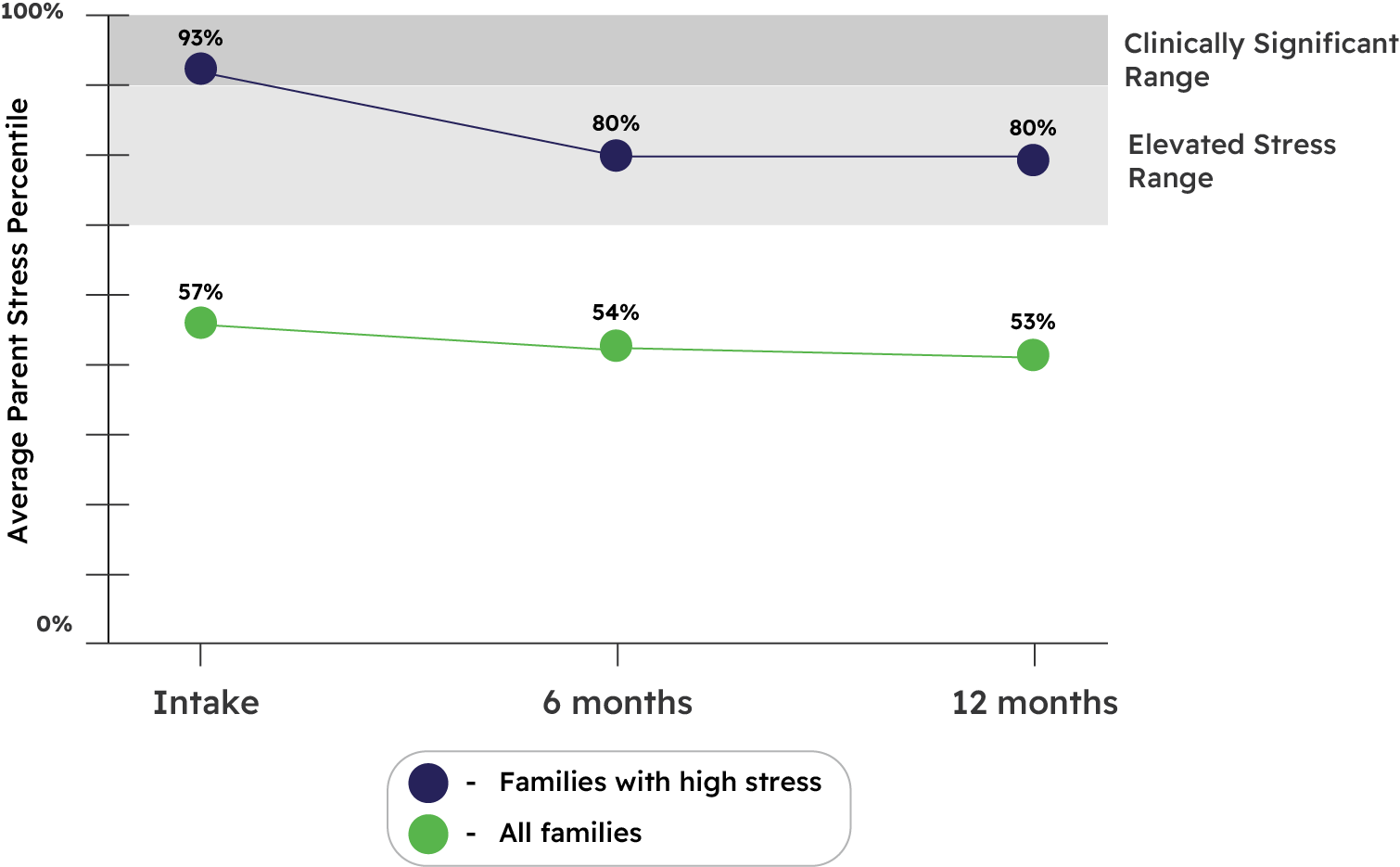
Outcome: Reduced parenting stress in the first year of therapy
Starting ABA therapy can feel like a big step for families, but research shows that it often brings more peace, not more pressure. In a study, 298 Action Behavior Centers families completed the Parenting Stress Index to indicate their stress levels throughout their child’s first year of Early Intensive Behavioral Intervention (EIBI).2
Families completed a short questionnaire about parenting stress when they started therapy, at six months, and again after one year.
- Average stress levels improved: Families’ scores dropped from the 57th percentile at the start of therapy to the 53rd percentile after one year.
- Families with the highest stress levels experienced the biggest relief: Those families reporting the highest stress levels (mean = 93rd percentile) had decreased scores to the 80th percentile within six months and maintained that progress after one year.
- Early support makes a difference: Starting ABA therapy early can help reduce stress for parents over time.
- Consistency matters: Regular therapy hours and ongoing communication help families feel supported and confident as their child grows.
School Placement Outcomes after ABA Therapy
Placement reported approximately seven months after a child exited care.
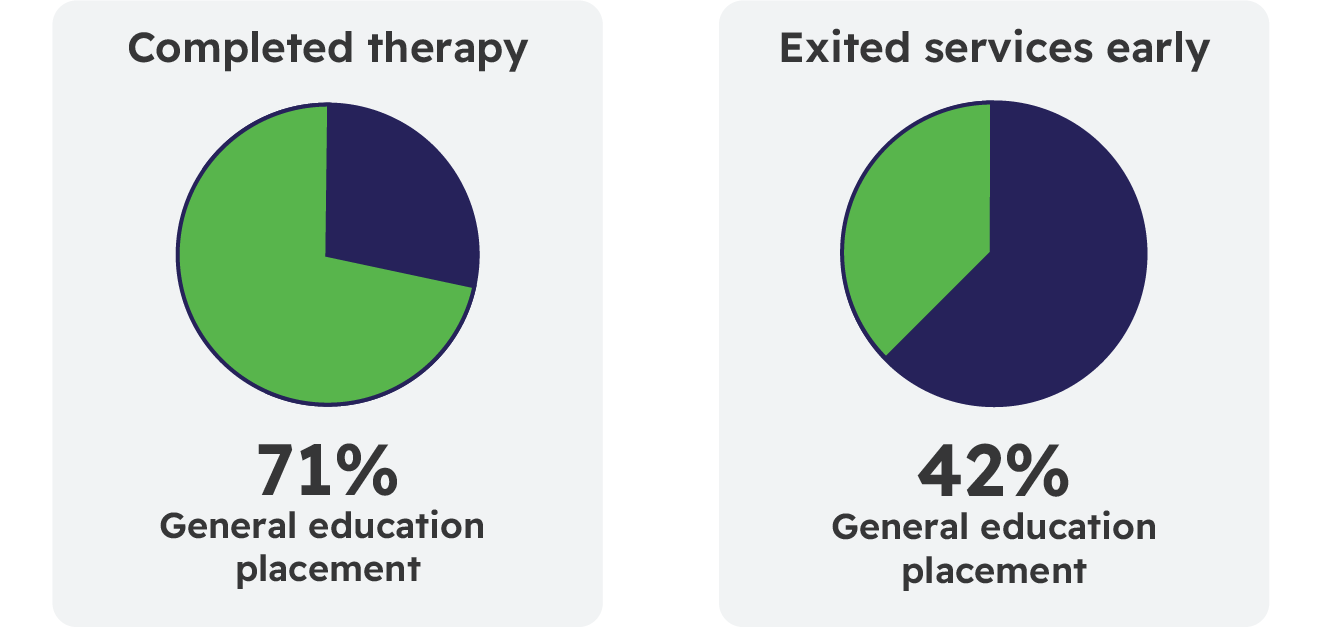
Outcome: ABA therapy supports school readiness and placement outcomes
At Action Behavior Centers, our goal is to help children build the skills they need to thrive in school and beyond. To understand how our graduates adjust after therapy, we follow up with families about seven months after their child transitions out of care to learn more about their school experiences.
In a study of 193 families, we found clear differences in school placement between children who completed therapy and those who exited early:3
- Greater inclusion after graduation: 71% of children who completed therapy spent most or all of their time in general education settings.
- More challenges for those who left early: 58% of children who exited services prematurely spent most or all of their time in special education or alternative placements.
- Completion matters: Staying in ABA treatment until your child’s clinical team recommends graduation can improve readiness for school.
- Early intervention builds lifelong skills: Communication, social, and independence skills developed through ABA therapy help children succeed in classrooms and community settings.
Our ongoing research
At Action Behavior Centers, we’re committed to advancing autism research that reflects the diversity of the families we serve.

One of our current projects focuses on the Autism Impact Measure (AIM), a parent-reported tool that tracks how core characteristics of autism affect a child’s everyday life.
Early research shows that the AIM is a reliable and meaningful way to measure progress over short periods of time. However, most published studies have not included diverse samples that represent different races, ethnicities, and primary languages.
To help close this gap, Action Behavior Centers is partnering with Western Psychological Services and other community providers to ensure that future research on the AIM better reflects the full range of families and communities who benefit from autism therapy.
Frequently asked questions

How can parents be involved in the research process?
Parents are essential members of their child’s care team. You’ll share feedback, attend progress meetings, and participate in Family Guidance sessions. Your insights help us continually improve therapy for your child and others. We also invite parents to take part in occasional surveys or parent-reported measures, which help shape future research and support even stronger clinical practices.

When should a child transition out of ABA therapy?
Transitioning from ABA therapy depends on several factors, including each child’s progress and developmental needs. As your child matures, their needs may shift, indicating it’s time to consider other interventions or supports. It might be time to consider transitioning if:
- Your child is consistently meeting ABA treatment goals
- Your child can apply skills learned in ABA across different settings
- The frequency of your child’s ABA therapy sessions is decreasing steadily
- Caregivers feel confident in reinforcing learned skills without ABA therapy support

What happens after therapy ends?
ABC helps families prepare for the next step in their child’s journey. Your team will review progress, share recommendations, and connect you with school or community supports to ensure a smooth transition.

How can I learn more about ABC’s research?
Families can visit our Outcomes & Research page or talk with their BCBA about how we collect and use data to improve care. We’re happy to share findings and explain what they mean for your child’s individual needs and goals. You can also explore our published studies and ongoing research partnerships to see how ABC continues to advance evidence-based care for children and families.

Center-based ABA therapy takes place in bright, engaging environments led by dedicated therapists. Children learn communication, independence, social interaction, and school readiness skills through individualized, evidence-based strategies. Available nationwide.