How ABA Therapy for Autism Supports Social Skills

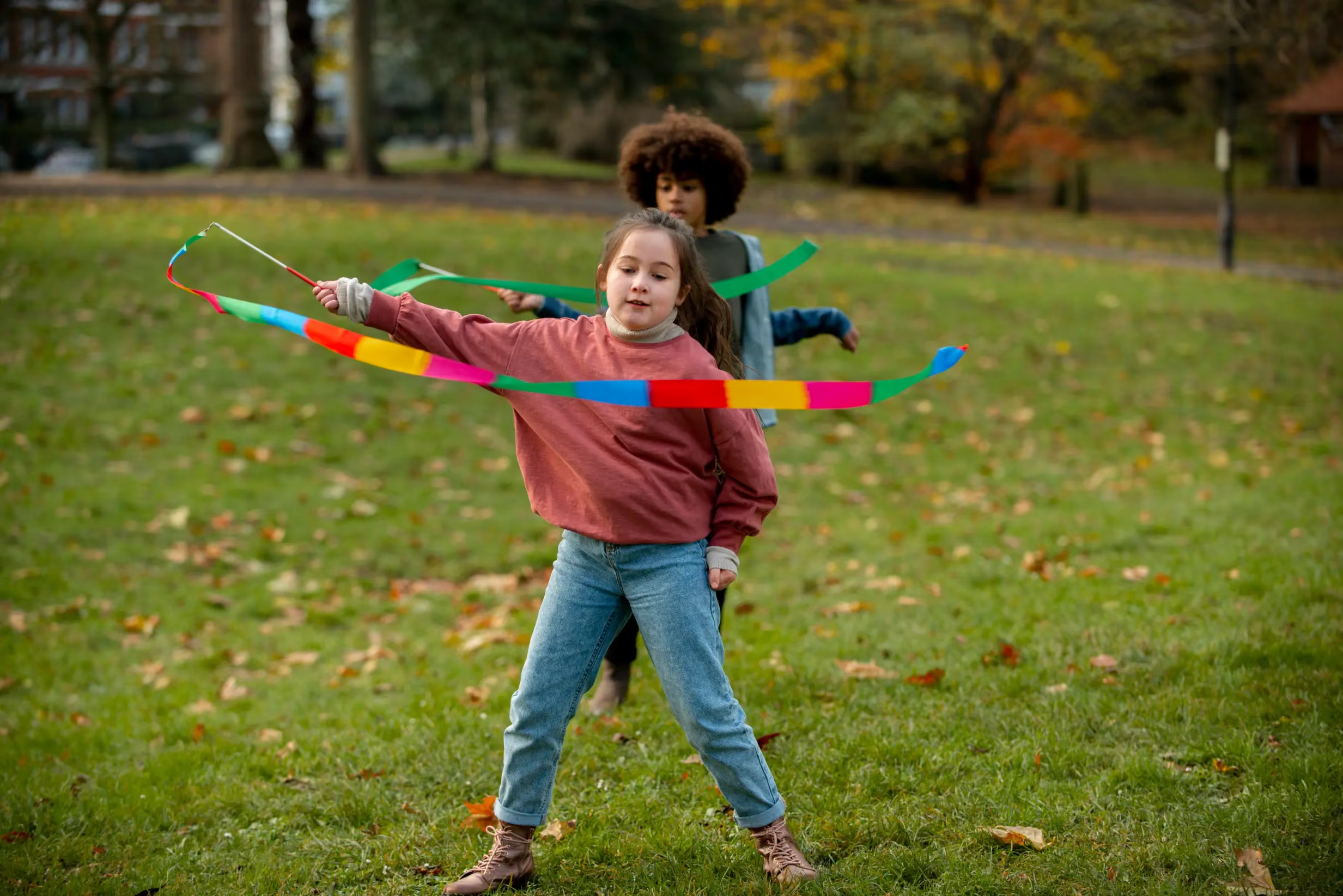
Have you noticed that your child stands near other children on the playground, but doesn't quite join in? Maybe your child wants to connect but doesn’t know what to say, when to speak, or how to take turns. If this sounds familiar, you’re not alone. Many children diagnosed with autism spectrum disorder (ASD) want friendships and connections, but social interaction can feel confusing or unpredictable.
Social challenges are one of the most common concerns parents of autistic children share with us. The good news is that social skills can be taught through individualized applied behavior analysis (ABA) therapy.
What are social skills?
Social skills are the tools we use to connect with other people. They help us understand what others may be thinking or feeling, take turns in conversations, solve problems, and make decisions. Social skills also include showing empathy, being flexible, and responding appropriately during conversations.
Many children learn these skills naturally by watching others and practicing over time. They slowly build a kind of “social map” that helps them know what to do in different situations. For some children diagnosed with autism, that social map needs to be taught more clearly and directly.
Why social skills can feel hard for autistic children
Autism spectrum disorder affects how a child understands communication and social information. Because so much of social interaction is unspoken, everyday situations can feel confusing or overwhelming.
Some autistic children may seem less interested in social situations. Others want to connect but struggle to understand unwritten social rules. It can feel like everyone else knows the rules except your child.
Your child might:
- Have trouble reading facial expressions
- Struggle with back-and-forth conversation
- Not know when it’s their turn
- Become upset when they lose
- Feel anxious around new peers
These challenges are not character flaws, and they are not a result of your child not “trying hard enough.” They simply reflect an area that needs some extra support.
What are social skills programs for children diagnosed with autism?
Many parents ask about social skills programs and whether they are helpful for their autistic child. A social skills program is a supportive learning approaches that help children diagnosed with autism learn how to interact with others with greater confidence and understanding in social situations.
While many children pick up social skills naturally, autistic children often benefit from clearer instruction and guided practice. The goal is not to change who a child is; it’s to give them tools to communicate, connect, and advocate for themselves.
At Action Behavior Centers, we provide ABA for social skills. Rather than using a one-size-fits-all curriculum, each child begins with a comprehensive social skills assessment conducted by a Board Certified Behavior Analyst® (BCBA®). Based on that assessment, we develop goals in collaboration with families that target the specific areas where support is needed.
→ Learn more: Center-based ABA therapy
How social skills are taught in ABA therapy
In social skills ABA therapy, skills are taught intentionally using evidence-based approaches:
- Discrete trial teaching (DTT) breaks skills into small, clear steps. A therapist may teach one part of a skill at a time, provide support, and reinforce progress. This approach is helpful when a child is first learning a new concept, such as recognizing when it is their turn.
- Natural environment teaching (NET) focuses on practicing skills during real-life interactions. Instead of teaching only at a table, therapists look for natural opportunities throughout the day. A child might practice asking for a toy during playtime or taking turns during an activity with a therapist.
By combining focused teaching with practice in natural settings, children learn not only what to do, but when and how to use their skills.
What does an ABA social skills program look like day to day?
An individualized social skills program often focuses on practicing skills during everyday interactions, where they matter most.
That might look like:
- Practicing turn-taking during a board game
- Waiting while another person speaks
- Asking for help instead of grabbing
- Using words instead of hitting
- Handling disappointment without shutting down
RBTs collect data throughout the day to measure progress, and BCBAs adjust goals over time. Skills are taught in a thoughtful sequence, so children build strong foundational abilities before moving to more complex social situations like school, where there are fewer adults and more children.
Practical strategies ABA therapists use to teach social skills
ABA therapists use a variety of tools during social skills therapy to support social learning.
- Social stories are short, written stories, often paired with pictures, that explain a specific situation and what to do. They may describe what the child is thinking and what others might be thinking.
- Example: “When I hit my friends, they feel sad and do not want to play. When I keep my hands to myself, my friends feel happy, and we can keep playing.”
- Comic strip conversations use simple drawings and thought bubbles to show what each person might be feeling during an interaction. For children who have difficulty reading emotions, seeing them visually can be very helpful.
- Teaching unspoken social rules is another important part of an ABA social skills program. Many children pick up these rules naturally, but they are rarely explained out loud. ABA therapists clearly teach these “dos and don’ts” so children are not left guessing.
- Example: you do not open someone else’s birthday presents, and you do not eat a classmate’s lunch without asking.
- Social scripts are short examples of what to say in common situations. Children practice them through role play with a therapist or peer. Over time, the goal is not memorization, but confidence and flexibility in real conversations.
Does ABA help with social skills?
Research shows that intentional, consistent social skills teaching can meaningfully improve social interaction for children diagnosed with autism.1
Research also shows that progress is strongest when therapy is consistent and parents are involved. When families reinforce skills at home, children are more likely to use those skills in everyday settings.2
Get started with individualized social skills support at Action Behavior Centers
At Action Behavior Centers, we provide evidence-based, personalized ABA therapy for social skills for children diagnosed with autism. Social goals are part of many children’s individualized treatment plans. With immediate access to care and many ABA therapy centers nationwide, you can get started right away. We also offer diagnostic support services to help your child be evaluated for possible autism. Contact us today to get started.
At Action Behavior Centers (ABC), we help children diagnosed with autism spectrum disorder (ASD) reach milestone moments. Compassionate care is at the heart of everything we do, and our highly trained clinicians deliver evidence-based applied behavior analysis (ABA) therapy tailored to each child’s unique needs.
Our autism services include diagnostic support, 1:1 individualized care, parent training, school readiness programs, and Early Intensive Behavioral Intervention (EIBI) across hundreds of centers in Arizona, Colorado, Illinois, Minnesota, North Carolina, and Texas. Because no family should have to wait for help, ABC offers immediate access to care. Contact us today to get started.
.avif)
.avif)