ABA Therapy at Home
Action Behavior Centers provides applied behavior analysis (ABA) therapy at home for children ages 18 months to 13 years diagnosed with autism spectrum disorder (ASD). Our in-home ABA services bring therapy directly into your child’s familiar environment to make learning meaningful, personalized, and engaging. ABC at Home serves families in Austin, Dallas, Houston, and San Antonio, Texas.

.jpg)
Home-based ABA therapy reviews and family testimonials

Very happy with ABC and all the therapists. They are all so sweet and nice, always willing to help in any way they can. My son loves going to "school" everyday and loves his therapists so much. I always leave with a peace of mind knowing they are taking good care of him and as a parent, that is the most important thing. We are so lucky to be part of the ABC family. I cannot recommend this place enough, absolutely happy with everyone here.


The staff here is on point! I would highly recommend registering in this ABA program. Our son is 4 years old and has shown major improvement since he’s been enrolled (1.5 months). Never have had a bad experience, all of the therapists here are very good with all children from what I’ve witnessed. The director always greets us at the door at drop off and pick up with a very positive attitude. We have really enjoyed the warmth from this center! Our child has progressed very well in the little time that he has attended. Would rate 10 stars if possible! If you’re looking for a kind and compassionate environment for your children, would definitely consider ABC.
-shirt.jpg)
At-home ABA therapy for autism
Action Behavior Centers (ABC) offers evidence-based ABA therapy at home for children diagnosed with autism in Austin, Dallas, Houston, and San Antonio, Texas. Therapy is provided by a caring team of Board Certified Behavior Analysts® (BCBAs®) and Registered Behavior Technicians® (RBTs®). Our ABA therapy approach is effective and designed to meet your child’s unique needs.
ABC at Home may be best for children who:
- Need highly-focused therapy to reach developmental goals
- Learn best in their natural home environment
- Thrive with one-on-one attention from trained professionals
Why choose at-home ABA vs. center-based ABA?
Working in the home allows therapists to connect closely with families and build strong one-on-one relationships. Home-based ABA therapy may be the best fit when:
- Parents want to see their child’s progress unfold right at home
- Child may benefit from strategies woven naturally into daily routines
- A child’s needs make home the safest environment
- Older children have outgrown center-based early intervention programs
Some children begin therapy in an ABA center and later transition to at-home care, while others start at home from the beginning. Either way, your child’s BCBA works hand-in-hand with your family to make sure growth happens where it matters most.
%201.webp)
What to expect during an in-home ABA therapy day
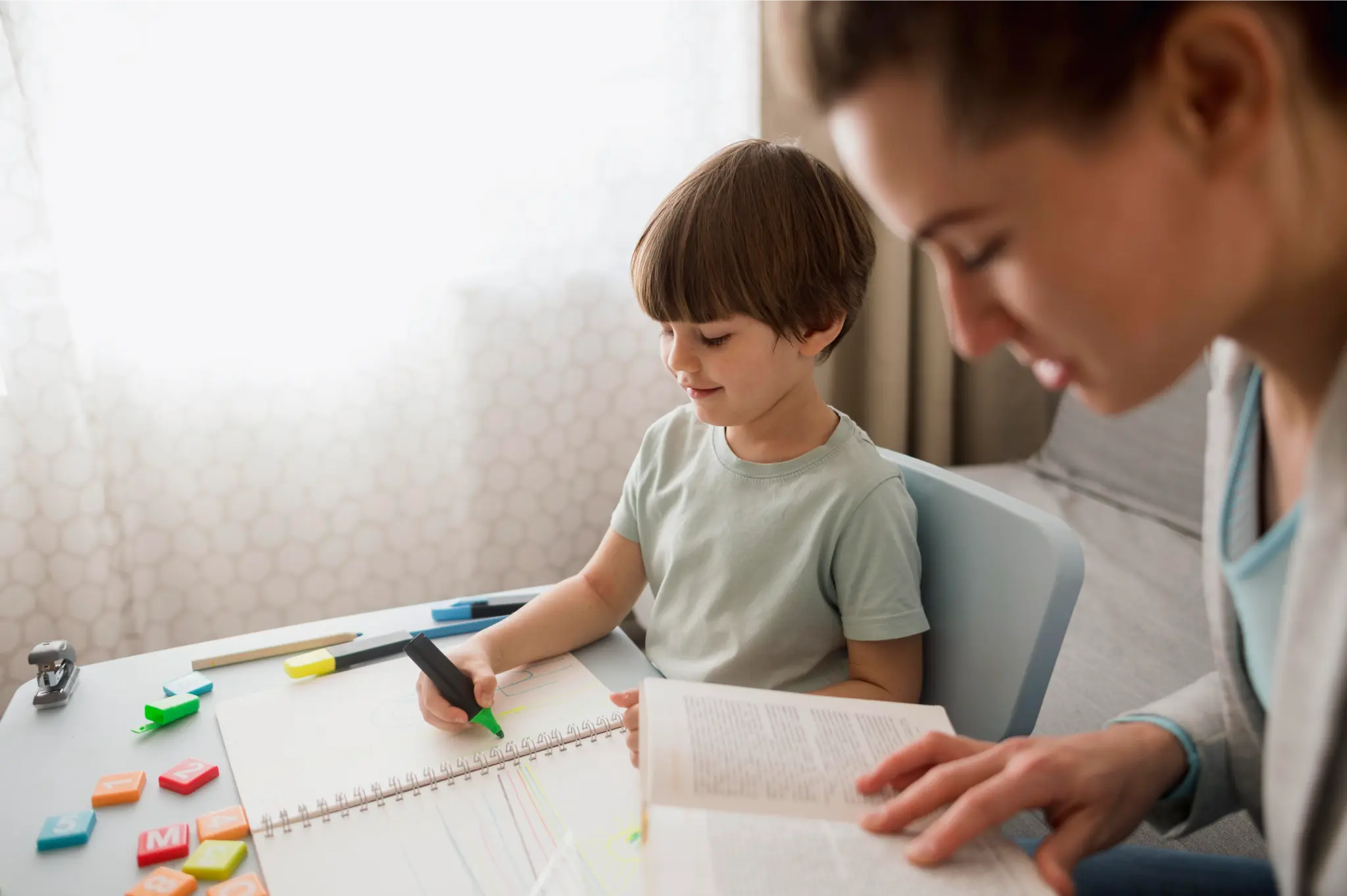
At Action Behavior Centers, home-based ABA therapy for autism is tailored to your child’s unique needs. Early sessions focus on helping your child feel safe, welcome, and ready to learn.
Your child’s journey begins with a skills-based assessment by a BCBA to identify needs and set individualized therapy goals. A dedicated ABA therapy team then provides sessions in your home that are coordinated with your family’s schedule.
.jpg)
1. Morning Check-in
Each session begins with a morning check-in, where the BCBA reviews the day’s goals and discusses any updates or challenges. This ensures the therapy plan is adjusted as needed to stay aligned with your child’s needs.
.png)
2. One-on-one therapy time
During one-on-one therapy, therapists use positive reinforcement and evidence-based ABA therapy strategies, including Discrete Trial Training (DTT) and Natural Environment Teaching (NET), to target specific goals.
.png)
3. Real-time progress tracking
Real-time progress tracking allows therapists to collect data on your child’s progress throughout the session. This ensures that goals are continuously updated and the therapy is adapted as needed based on the child's needs.
-shirt.jpg)
4. Ongoing parent updates
Parents receive regular updates on their child’s progress, including milestones and new therapy strategies. This keeps families informed and involved in the process, allowing them to reinforce skills at home and support ongoing development.
.png)
How can ABA therapy help my child?
ABA therapy delivered in the home environment can help children learn and develop a range of important skills, including:
- Communication skills: verbal language, gestures, nonverbal communication
- School readiness skills: imitation, matching, categorizing
- Behavior support: reducing aggression, self-injury, property destruction
- Social skills: conversation, play, peer interaction
- Self-care skills: daily routines like washing hands or getting dressed.
Every child’s goals are individualized to their needs and your family’s priorities. Goals are updated as your child grows.
How to enroll in home-based ABA therapy
ABC at Home is available for families in Austin, Houston, Dallas, and San Antonio, Texas. To learn more about enrollment, contact an ABC at Home location near you.
Reach out to our At Home team
Start by filling out our online interest form to connect directly with the ABC at Home team. A teammate will follow up to learn more about your child and your family’s needs.
Complete screening or evaluation
If your child already has an autism diagnosis, we’ll review next steps together. If your child does not yet have a diagnosis, we follow the same clinical pathway as our centers, which may include the M-CHAT-R, CAST, and/or an ADOS-2 evaluation.
Confirm fit and complete an in-home assessment
Families will meet virtually with an Operations Manager (OM) to discuss if At Home is the right fit. Then, we’ll schedule an in-home assessment where a BCBA completes the clinical assessment and the OM ensures the home environment can safely support therapy.
Ready to take the next step?
Use the map to check whether your home is within our ABC at Home service area. We provide home-based ABA therapy to families across major Texas metropolitan areas.
Select a region:

.avif)

Haslet
Aubrey
Frequently asked questions

How long will my child need home-based ABA therapy?

Are parents involved in home-based ABA therapy?
Yes! Parents and caregivers are key to their child’s success. At home, you’ll have many opportunities to stay involved, including:
- Participating in Family Guidance with your child’s BCBA
- Learning strategies to practice during daily routines
- Receiving real-time updates and coaching during sessions
We believe ABA therapy works best when families and therapists work together as a team.

How do I know if my child is making progress in home-based ABA therapy?
Your child’s therapy team collects data during every session using digital tools and skill-tracking systems. BCBAs also complete regular assessments to measure growth.
You’ll stay informed through:
- Written progress reports
- Easy-to-read graphs showing skill development
- Ongoing updates during parent meetings
- Direct communication from your clinical team
Therapy goals are always updated based on what your child needs to keep growing.

How is play-based early intervention used in at-home ABA therapy?
Play is an important part of Early Intensive Behavioral Intervention (EIBI). Children learn best when they’re having fun, so we use everyday play activities to teach communication, independence, and social interaction.
Examples include:
- Building with blocks or puzzles
- Pretend play, like cooking or shopping
- Matching, sorting, and counting games
- Singing, dancing, or interactive storytime
- Turn-taking games like rolling a ball or “Simon Says”
These activities help children practice new skills in a way that feels natural and enjoyable.

How do therapists use positive reinforcement in home-based ABA therapy?
In home-based ABA therapy, therapists use positive reinforcement to help children stay motivated and excited about learning. Reinforcement is personalized for each child. Here's how therapists apply positive reinforcement:
- Offering praise and encouraging words like "Great job!" or "Well done!" immediately after learning a new skill.
- Allowing access to activities the child enjoys, such as playing with a favorite toy.
- Using a reward system where children can earn stickers or tokens, which can be exchanged for a preferred activity or item.