New Research Published by the AIoR Highlights Skill Growth Outcomes in ABA Therapy at ABC

How do you know whether the skills you teach in applied behavior analysis (ABA) therapy carry over into a child's daily life? At Action Behavior Centers, Board Certified Behavior Analysts® (BCBAs®) track that with regular, standardized assessments. Our Action Institute for Outcomes Research (AIoR), led by Dr. Linda LeBlanc then studies those results across hundreds of children. New peer reviewed research from the AIoR show how children diagnosed with autism spectrum disorder (ASD) build skills over the course of ABA treatment.
How do BCBAs at ABC measure a child's skill growth?
At intake and every six months, BCBAs at ABC assess each child's skills using two tools:
- Vineland Adaptive Behavior Scales, Third Edition (VABS-3): Looks at everyday skills, such as communication, socialization, and daily living.
- A curriculum assessment, such as the Verbal Behavior Milestones Assessment and Placement Program (VB-MAPP): Looks at language, learning, and social skills milestone by milestone.
Those results guide what BCBAs teach next, how they set individualized goals in collaboration with families, and when a child may be ready to graduate from ABA therapy. Learn more about how ABC measures outcomes in ABA therapy.
What did the VB-MAPP research find?
AIoR's first large-scale analysis of VB-MAPP change scores was published in Behavioral Interventions.¹ Researchers looked at scores for 282 children at ABC.
- On average, VB-MAPP scores rose 69.6 points over about 1.5 years of treatment.
- The steepest growth came between the first and second assessments.
- VABS-3 communication, socialization, and Adaptive Behavior Composite scores correlated moderately to strongly with VB-MAPP scores, and those correlations grew stronger over time.
For BCBAs, that's a useful check. Progress on curriculum goals tended to track with the adaptive skills children use at home, at school, and in the community. Read the full study, or see more of AIoR's published research.
What did the Vineland research find about early intensive treatment for autism?
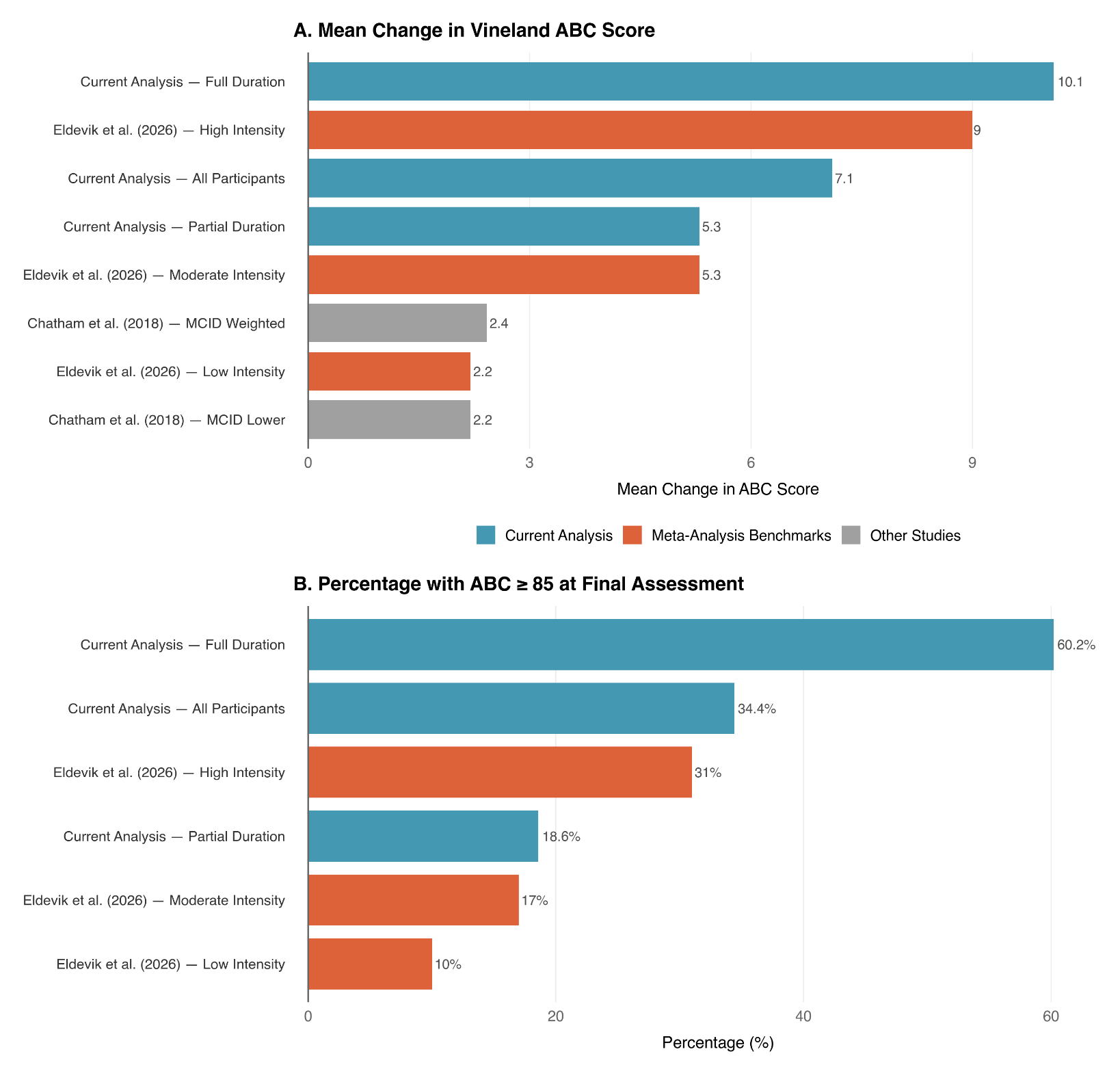
A second AIoR analysis, now under peer review, looked at VABS-3 scores for more than 250 children who received EIBI at ABC.
- Children who completed the recommended duration of EIBI (98 children): 60.2% scored 85 or higher at discharge, with Adaptive Behavior Composite scores improving by an average of 10.07 points.
- Children who received part of the recommended duration (161 children): 18.6% scored 85 or higher at discharge, with an average improvement of 5.15 points.
A score of 85 or higher falls in the nonclinical range. These outcomes were comparable to recently published benchmarks² and well above the published minimum clinically important difference,³ the smallest change considered clinically important.
"Regular assessment gives our BCBAs and families a clear picture of what each child is learning and what to focus on next," said Dr. Linda LeBlanc, Executive Director of AIoR. "Sharing these findings helps hold ABA treatment providers to a high standard of care and gives families information they can use when making decisions about their child's care."
Every child's progress looks different. At ABC, BCBAs use ongoing data to adjust goals and talk with families about the recommended duration of treatment for their child.
What do these findings mean for BCBAs at ABC?
Outcomes research is part of daily clinical work at ABC. As a BCBA here, you'll:
- Assess each child at intake and every six months with tools like the VABS-3 and VB-MAPP
- Use assessment results to set individualized goals in collaboration with families
- Share progress with families during twice-monthly Family Guidance sessions
- Practice at an organization that publishes its treatment outcomes in peer-reviewed journals
BCBAs also have access to CEUs from Dr. LeBlanc and Dr. Gregory Hanley, Executive Director of Compassionate Care, and Chief Clinical Officer Dr. Charna Mintz. Explore ABC's outcomes research or meet the clinical research team. ABC also supports BCBAs as they grow into supervisors. Read how ABC helps new BCBAs build strong supervisory relationships.
How the AIoR connects science to real-world practice
The AIoR’s mission is to improve quality, transparency, accountability, and equity in outcomes for autistic individuals and their families. Its team analyzes data from thousands of families and brings research findings into clinical care.
What the research shows:
- Challenging behaviors: Children learned safer ways to communicate and aggression, property destruction, and self-injury dropped steadily during treatment, with an 86% decrease in target behaviors.⁴
- Parent stress: Parenting stress went down during the first year of ABA treatment, and families who started with the highest stress saw the biggest drop, from the 93rd to the 80th percentile.⁵
- School placement: 71% of children who completed their recommended ABA treatment entered school spending most or all of their day in general education.⁶
How ABC measures and reports ABA treatment outcomes
Clinical Directors review each childʼs treatment through structured case review and auditing, and we track four process-quality areas against defined goals: teammate hiring and training, manageable caseloads, service fulfillment, and family engagement. AIoR operates separately from clinical operations, on purpose, so its findings stay objective and accountable. Many results appear in peer-reviewed journals, and process metrics like RBT® certification and Family Guidance sessions are reported openly each year.
Ready to take the next step?
If you're a BCBA looking for a role grounded in compassion and evidence-based outcomes research, explore BCBA careers at ABC. Curious what clinical leadership looks like day to day? Read A Day in the Life of a BCBA® Clinical Director at Action Behavior Centers. If you're a Registered Behavior Technician® (RBT®) ready to grow your ABA career, learn about the Everest Program or view open roles.
At Action Behavior Centers (ABC), we help children diagnosed with autism spectrum disorder (ASD) reach milestone moments. Compassionate care is at the heart of everything we do, and our highly trained clinicians deliver evidence-based applied behavior analysis (ABA) therapy tailored to each child’s unique needs.
Our autism services include diagnostic support, 1:1 individualized care, parent training, school readiness programs, and Early Intensive Behavioral Intervention (EIBI) across hundreds of centers in Arizona, Colorado, Illinois, Minnesota, North Carolina, and Texas. Because no family should have to wait for help, ABC offers immediate access to care. Contact us today to get started.